What Weight Dumbbells Should a Woman Start With?

Joanna Sirak · 6 min read
Joanna Sirak · 6 min read
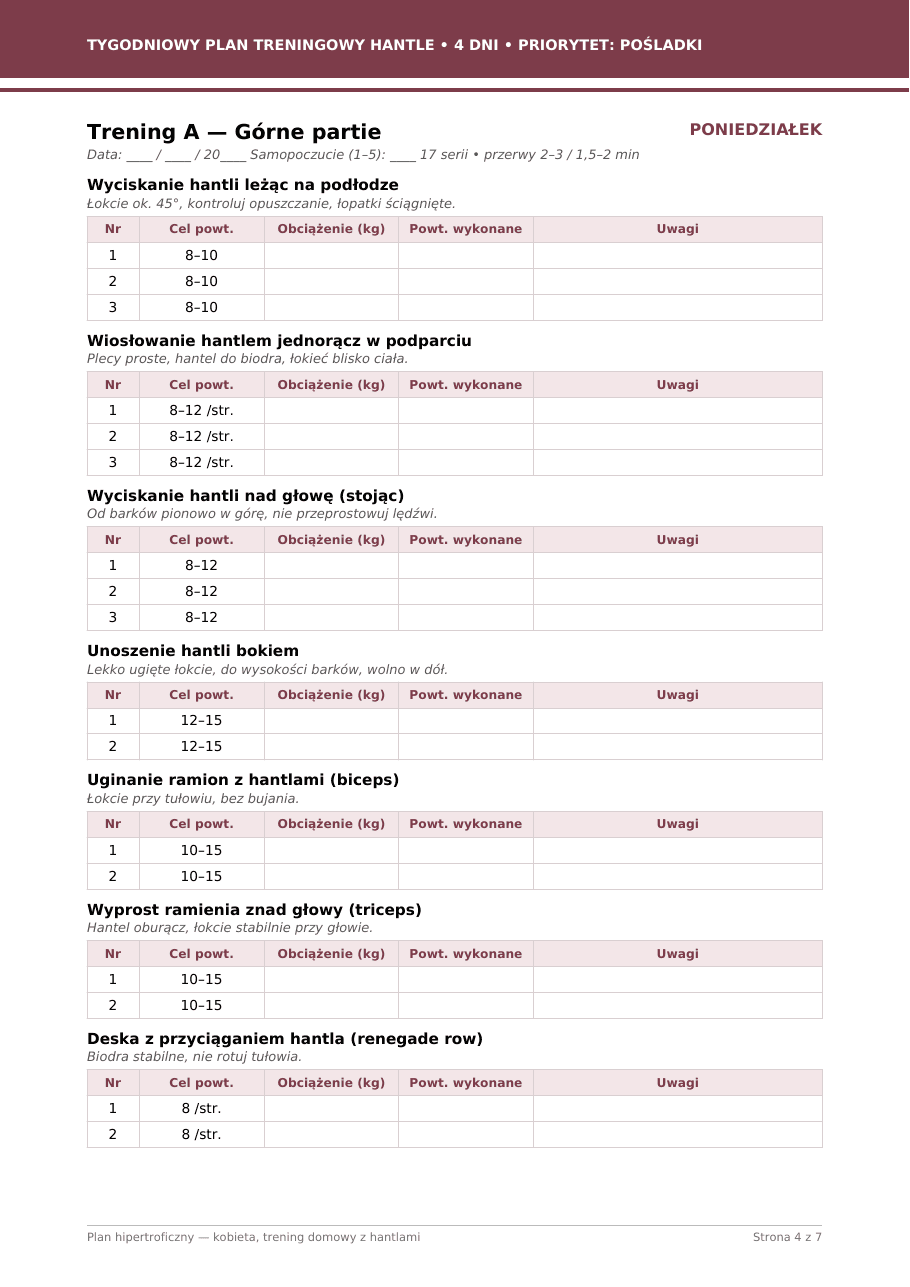
What weight dumbbells should a woman use to start? Pick the weight you can lift for 8 reps with good form and still have 2-3 reps left in the tank. For many women starting at home, that means 4-8 kg for upper body exercises and 8-12 kg for squats and hip thrusts. Treat it as a starting point to test, not a rule.
How often? Train each muscle group twice a week: four workouts a week, or three if that's all the time you have. Below I explain where these numbers come from and how to find your own.
From the reps you have left, not from a table. The same 6 kg dumbbell is a warm-up for one woman and too heavy to press overhead for another. That's why my plan never says “take 6 kg”. It gives a rep range and an RIR instead: reps in reserve, the number of reps you could still do.
The test is simple. Pick up a weight and do a set until you feel you could manage only two more reps, then count how many you did. If it was 8-10, the weight is right for now. If it was 15 or more, go heavier. If it was 5 and your form is already slipping, go lighter. Calibrating takes one set per exercise.
Adjustable ones, if you can. A pair of fixed 5 kg dumbbells will do for two weeks of rows and then gather dust in a corner. In stiff-leg deadlifts and hip thrusts you'll soon reach 15-20 kg in each hand, while 4 kg for lateral raises will stay with you for a long time. One set that adjusts from 2 to 20 kg covers both ends of that scale.
If you buy fixed dumbbells, get three pairs in different weights rather than one “all-purpose” pair. Add a bench, or anything stable at knee height, for hip thrusts and step-ups. You don't need bands, machines or belts.
These are rough figures for someone who has never done strength training or is coming back after a long break. Weights are per dumbbell unless stated otherwise. Check them with the reps-in-reserve test above; yours may be different, and that's fine.
| Exercise | Rep range | Starting weight |
|---|---|---|
| Dumbbell sumo squat (one dumbbell) | 8-12 | 8-12 kg |
| Romanian deadlift (two dumbbells) | 8-12 | 8-12 kg each |
| Dumbbell hip thrust (one dumbbell) | 8-12 | 10-16 kg |
| Step-up (two dumbbells) | 10 per leg | 4-8 kg each |
| Dumbbell chest press | 8-10 | 5-8 kg each |
| One-arm row | 8-12 | 6-10 kg |
| Overhead press | 8-12 | 3-6 kg each |
| Lateral raise | 12-15 | 2-4 kg each |
| Biceps curl | 10-15 | 3-5 kg each |
Notice the gap: your lower body can lift two or three times as much as your shoulders. That's normal and doesn't mean you have “weak arms”. It means your glutes and thighs are the biggest muscles in your body.
For lateral raises, yes: 2-4 kg is a normal start, and 3 kg is the bottom of the range for an overhead press. For the chest press and the one-arm row they're usually too light. What most people mean by toning is building a bit of muscle, so pick a weight that leaves you only 2-3 reps in the tank at the end of a set.
It depends on the exercise. For an overhead press, yes, at the start. For a sumo squat or a Romanian deadlift, 10 kg sits right in the 8-12 kg starting range, and in deadlifts and hip thrusts you'll soon go past it. The test is the same: the reps you have left, not the number on the dumbbell.
Each muscle group twice a week. In practice that means four workouts: two for the upper body and two for the lower body, arranged so there is at least one rest day between sessions for the same muscles. My free plan does this on Monday, Wednesday, Friday and Saturday.
If you've got time for three workouts, do two lower body and one upper body one week, then swap the next. If you've got time for two, train your whole body each time. One workout a week still counts, but progress will be so slow that it's hard to notice, and noticing progress is the main fuel that keeps you going.
When you reach the top of the rep range in every set of an exercise. Here's an example with an 8-12 range and three sets. Workout one, 10 kg: 8, 8, 8. Workout two, 10 kg: 9, 8, 8. A few workouts later, 10 kg: 12, 12, 12. At the next workout you pick up 12 kg and drop back to around 8 reps.
A jump of 2-5% sounds like nothing, but it's exactly the pace at which muscles keep up and joints don't complain. On adjustable dumbbells it's usually the smallest plate available. If an exercise has no smaller jump, add a set instead of a kilogram.
First check your sleep and your food, especially protein: without building material, a muscle has nothing to grow from. Then check your rest periods: 2-3 minutes on compound lifts, not 45 seconds. Then check your log: are you really adding reps, or have you been doing the same 10 kg for 10 reps for three weeks?
If your numbers drop for 2-3 workouts in a row, you ache more than usual and you're sleeping worse, take a lighter week: the same exercises at 60-70% of the weight, with no sets close to failure. After a week like that, the weights usually start moving again.
In the Strength Start plan, every exercise has a rep range and columns for the weight and the reps you actually did. The first workout is calibration: you choose your weights with the reps-in-reserve test. From the second one on, double progression does the work. You need dumbbells and a stable support, four times a week for about an hour. For the full weekly routine, read weight training at home for women over 40.
If you have an injury, a chronic condition or diagnosed osteoporosis, or you're pregnant, talk to your doctor or a physiotherapist before choosing weights and exercises. The table above is general and educational, not a recommendation for you.