Weight Training at Home for Women Over 40

Joanna Sirak · 5 min read
Joanna Sirak · 5 min read
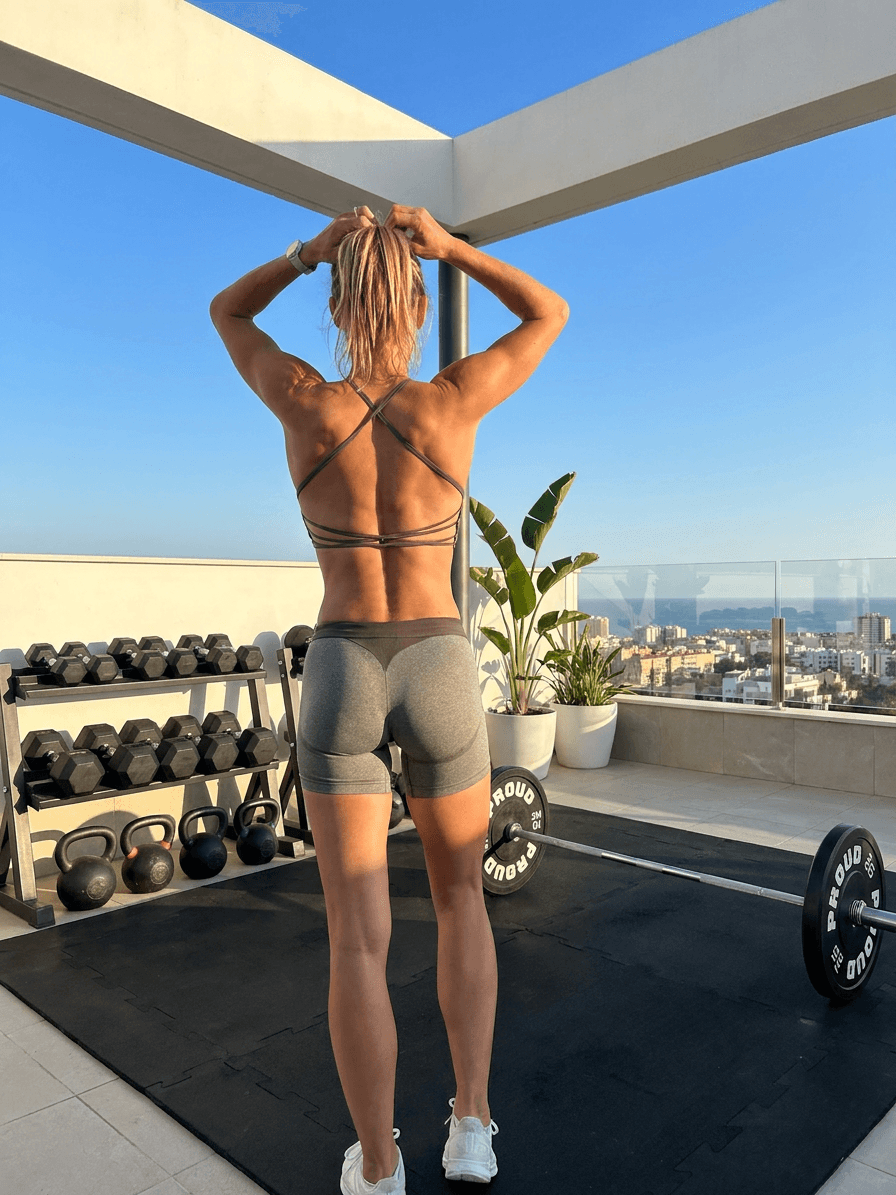
To start weight training at home after 40, you need a pair of adjustable dumbbells, a bench or a stable support, and four slots of about an hour a week. Start with a weight you can lift for 8 reps with 2-3 still in reserve. Then add reps every week, and only later add weight.
That's the whole secret. The rest of this post explains why it works and shows how it looks in my free plan.
Yes, in your 40s and in your 50s. Muscle responds to training at any age, as long as the stimulus is enough and it comes regularly. What changes after 40 isn't whether you can, but the conditions: recovery can be slower, sleep lighter, and your joints complain louder when your form is sloppy. That's why we start with the movement, not the weight.
Research on resistance training in middle-aged women shows roughly the same picture. Strength goes up quickly in the first weeks (because your nervous system is learning the movement), and muscle comes later, after a few months. If after two weeks you see no difference in the mirror but the dumbbell feels lighter, that's exactly this first stage. Everything's going to plan.
About 55-65 minutes, including the warm-up and rest periods. Shorter sessions make sense too, but then you cut exercises, not rest. Rest is part of the workout: give yourself 2-3 minutes on compound exercises (squat, stiff-leg deadlift, hip thrust, presses) and 1.5-2 minutes on isolation work. If you go back into a set out of breath after 60 seconds, the next set will be weaker. Not because your muscles are weak, but because you haven't caught your breath.
This is what a week looks like in my Strength Start plan:
| Day | Workout | Time |
|---|---|---|
| Monday | A: upper body | about 55-65 min |
| Tuesday | rest, a walk, stretching | as you like |
| Wednesday | B: lower body, glutes | about 55-65 min |
| Thursday | rest | as you like |
| Friday | C: upper body | about 55-65 min |
| Saturday | D: lower body, glutes | about 55-65 min |
| Sunday | rest | as you like |
Four workouts: two for the upper body and two for the lower body with the glutes as the priority. There's always at least one rest day between two sessions for the same muscles.
The ones that work a lot of muscle at once and can be loaded safely. For the lower body: the sumo squat with a dumbbell held at your chest, the Romanian deadlift, the hip thrust with your back against a bench, and the step-up onto a stable platform. For the upper body: the dumbbell press lying on the floor, the supported one-arm row, the standing overhead press and the lateral raise.
Don't start with single-leg exercises and don't start with pull-ups. First learn to feel your hips in the deadlift and your glutes at the top of the hip thrust. The harder versions will come naturally once the basics get boring.
Four times if you have the time, three if you don't. Training each muscle group twice a week gives your muscles a stimulus often enough while leaving you time to recover. One workout a week is still better than none, but progress will be slow and hard to measure. For more on choosing your weights, see what weight dumbbells a woman should use.
What matters more than the number of days? Not skipping weeks. Two workouts every week for six months will give you more than five a week for a month followed by a month off.
By the reps you have left. In the plan, every set shows an RIR: reps in reserve, the number of reps you could still do. RIR 2 means you end the set when two more reps are still possible, but a third one isn't. The last rep is slow and takes focus, but your back and knees are doing exactly what they did at the start.
A set also ends when your form breaks down, even if the counter says you have one rep to go. In the stiff-leg deadlift, the sumo squat and the Bulgarian split squat, this is rule number one. A rounded back doesn't build glutes.
With double progression. You choose a rep range, say 8-12, and a weight at which you reach the bottom of that range with RIR 2-3. Over the next workouts you add reps until you hit 12 in every set. Then you increase the weight by the smallest jump available, about 2-5%, and go back to 8.
That's why you write down every set: the weight and the reps you actually did. Without a log, double progression doesn't work, because a week later you won't remember what you did on Wednesday. In the plan, each workout has its own page with a table to fill in with a pen.
The Strength Start plan is the four workouts described above, with a warm-up matched to each day, a glossary of terms (RIR, technical failure, warm-up set, deload) and space for your results. For the exercises you need dumbbells and a bench or a stable support. No bands, no machines.
If you have a health condition, are coming back from an injury, have diagnosed osteoporosis or are pregnant, talk to your doctor or a physiotherapist before choosing exercises and weights. The plan is general and educational and doesn't replace that conversation.